
Warriors and Wusses: A Review of 'The Ethics of the Octagon' by Sean DeMars
Against Ad Hominems
In the promotion of his new book, there’s been more than a few snarky and slanderous attacks against Sean DeMars, author of The Ethics of the Octagon. The clearest demonstration of mental weakness are ad homs. Don’t get me wrong, I’ve read The Serrated Edge and can appreciate a nicely landed verbal jab (of the Wilsonian type), just as much as I appreciate a double spinning backfist (particularly from Shara Nurmagomedov).
Instead of ad hominem attacks to dismiss the question altogether, we might benefit from letting him make the case and dealing with it. One of my strongest peeves is when someone disagrees with me over a position I don’t even hold. I would much rather you disagree with what I actually believe than a caricature or imaginary belief assigned to me. Because of that, I decided to read this book with an open mind. It was brief and biblical. My opinion of Mixed Martial Arts (MMA) did change, though not in the way Sean intended.
What’s the Book Fighting For
Sean claims “I am no pacifist”[1] (1). After reading the entirety of the booklet, I don’t doubt that. I’m also friends with the guy on Facebook and I’ve seen jiujitsu photos—he is not a wuss. One example is where he “doubled down on the ethical permissibility of self-defense” (16). He clearly affirms that strong men must protect the weak. That the civil magistrate wields the sword and must be a terror to evildoers. He writes, “The sword is no empty symbol” (2). Therefore, one must admit that Sean is no pacifist.
The central argument of the book is that “professional MMA is sinful” (iii) and therefore Christians should not watch it or work in it. To be fair, if that is true, then he is absolutely right. Sin is an offense against a holy God and Christians should not take part in it. That’s what will need to be proven: MMA is sinful.
The book begins, as it should, in Genesis. He asserts that since there is no violence in the Garden prior to the Fall, and some of the immediate results of sin is violence, then violence is “not morally neutral; it’s one of the earliest and clearest fruits of the Fall” (1). Cain and Lamech were indeed murderous sinners. They were guilty, but is that a justified indictment on all of MMA? I’m not convinced.
It is possible to list all sorts of sinful examples of non-sinful behavior. Drinking alcohol is not sinful, though we can think of sinful examples. Having sex is not sinful, though again, we can think of sinful examples. In fact, you could even have sex with your wife alone, and it be sin, if you were coercing her, degrading her, or fantasizing of another. The act itself is not wrong, unless the intent is corrupted.
I’d like to argue against DeMars’ assertion that professional MMA is sinful because of the unnecessary and excessive violence of an image bearer for entertainment. Instead, I’d contest that the telos of MMA is an athletic competition with serious, but regulated violence, which is not the same as sinful violence. Where I’d agree with Sean is that it can become sinful.
A Matter of Intent
Years ago, I was really struggling with a pastor who was my direct report. He micromanaged me, blamed me when something was wrong, took the credit when something was good. Not cool. Well, after months of frustration and communication, it seemed like none of the elders were doing anything about it. I called another pastor and cried out, “Am I the problem?” I’ll never forget what he said. “No. You’re not the problem, but you can be.” I think the same is true for MMA. I do not believe it is inherently sinful, but the fighters can sin if they are not careful.
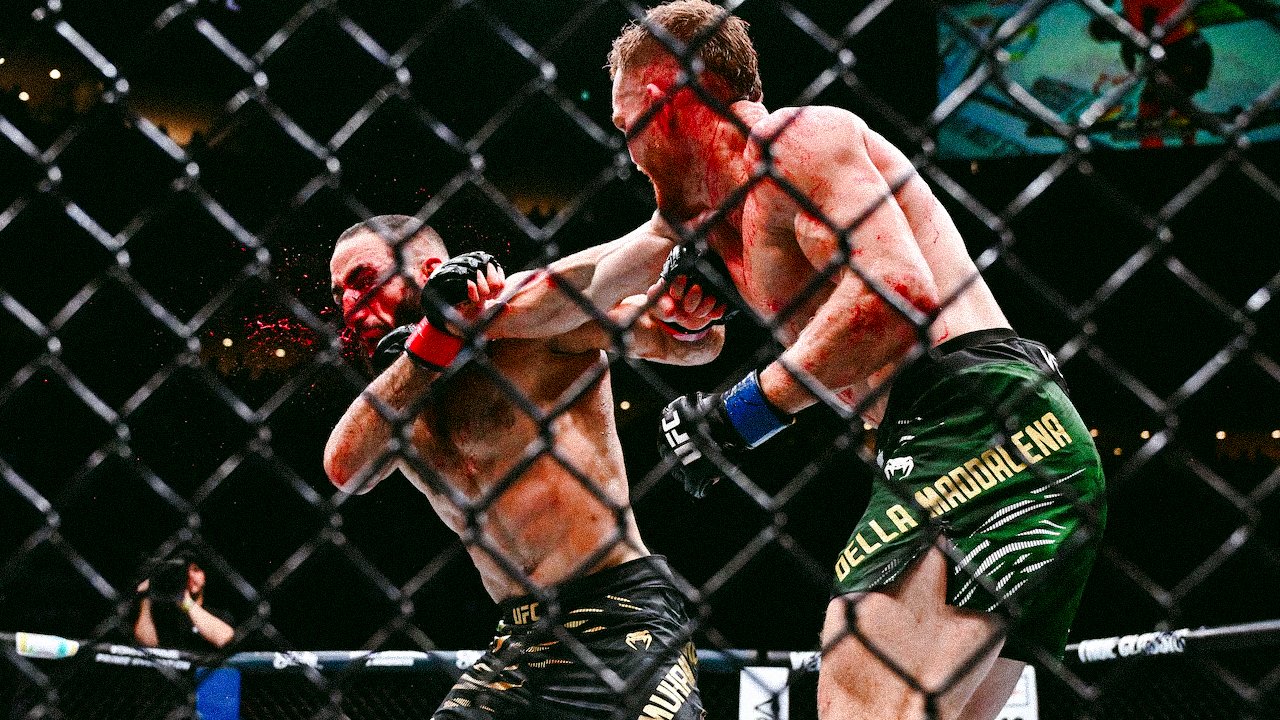
The examples Sean listed—Cain, Lamech, a bar fight—are sinful acts of violence marked by a deep hatred. There was murder in their heart before there was blood on their hands. In other words, intent matters. If a fighter has genuine disdain for his opponent, explodes in a fit of rage, is unwilling to let off the gas, and undeterred by the referee, then I would freely grant that that expression of MMA fighting is sinful. Where I’d pushback is that I don’t believe the vast majority of fighters are described that way. Look past the dramatized rivalry and trash talk; past the smeared blood and broken noses; look at the post-fight posture. These fighters are athletes who have a respect for their colleagues. Though there are certainly exceptions (cough—McGregor vs Khabib—cough).
What makes this disagreement difficult to write is that I actually agree with so much of what Sean wrote. I even agree with many of his definitions. My dissent is in the intent of the violence, degree of violence inflicted, and regulations of violence in effect. While I believe there is a brute and violent nature to the sport, it is not uncommon for a fight to end with the two warriors sharing hugs and handshakes—paying their respects to each other. Therefore, the intent is not to cause harm to the man personally.
If there was hatred in the heart of the fighter and they desired to cause severe physical harm to his opponent personally, then one would expect the degree of violence to be much greater. There would be a level of brutality to the fights where a group of men would need to intervene. Yet, we don’t see that happening in sanctioned UFC fights; there seems to be a level of restraint with the warriors themselves. Sean wrote, “Strength under control is not a vice, but a virtue” (16). Amen! However, I’d apply this to the warriors in the cage as well. They certainly are able to inflict much worse injury to their opponent, yet they do not. They respond to the clock, they acknowledge the submission, they (mostly) adhere to the rules and there are consequences if they don’t. Bleacher Report notes, “Despite the long-standing public perception of the sport as no-holds-barred human cockfighting, MMA has evolved from its arguably barbaric beginnings into a heavily regulated sport.”[2] There are illegal moves like head-butting, eye-gouging, groin strikes, and biting.
Sean defines the telos of MMA: “to incapacitate an opponent through physical harm” (4), and if that definition stands, his case largely follows. But the telos deserves some investigation. The fighter who sinks a rear-naked choke is not trying to harm his opponent in any morally relevant sense. He is trying to demonstrate superior skill, positioning, and endurance under pressure. The submission is the acknowledgment of that dominance, not the infliction of damage as an end in itself. This is why fighters tap and why their opponents immediately release. The means are constrained by the telos, not the other way around. If the telos is to genuinely harm the opponent, there would be no tap, no referee, no rules. Since MMA has all three suggests it is closer to an athletic contest than to barbaric violence.
I found Sean’s argument compelling; although I would more quickly use it as a warning against unrestrained aggression, not professional MMA as a whole. Additionally, I would agree that the bloodlust of the crowd is wrong. The cash-grabbing exploitation from the bigwigs and fancy-pants is wrong. The arrogance and carnal bravado are wrong. But these are warts to remove, not a sin to kill. One should hope that virtues like honor and prudence gain momentum in this sport and culture.
Don’t Be a Wuss
The reason I like MMA is because it is an unfiltered display of strength, stamina, and toughness. As a young man—yes, Gen Z—I am too familiar with how other men have placated the hard things in life. Don’t work, live at home. Don’t talk to girls, swipe right. Don’t think, use ChatGPT.
We are tempted to watch as a snake is flirting with our bride. We let our girl do the talking. We are lazy gluttonous cowards who hide behind the tree. Then we blame-shift. Just like our first dad—Adam. His sin was wussiness (synonym for passivity, abdication, and cowardous). He did not do the hard thing. He did not take it on the chin.
I like MMA because it’s one of many examples of doing the hard thing. Taking a punch and punching back. No, we are not to be unrestraint maniacs. But we should not be soft, fluffy wusses either. We need to relearn that “the glory of young men is their strength” (Proverbs 20:29). Andy Naselli offers a piercing exhortation: “Men, be strong and gentle—both tough and tender, authoritative and compassionate, brick and velvet.”[3]
Part of the contest is that it takes significant courage to step into the cage. However, it deserves to be said that these warriors willfully engage in a battle of might and mind. Who will outdo, outlast, and outmaneuver? Joe Rigney defines courage as “a stable habit of the heart that masters the passions, especially the passion of fear, through the power of a superior desire.”[4] In the same way that a boy looks to the endurance of a runner or the grittiness of a lacrosse player, they can look at a fighter and see his courage in the face of certain pain. That boy is being taught that he can endure all sorts of opposition, he can take a hit and get up, he can adjust to the present obstacle and attack with creativity and intentionality.
Men need to recover the ability to take on voluntary hardships. What I benefited most from reading The Ethics of the Octagon was a sobering reminder that strength under control is virtuous. That murder in the heart leads to blood on the hands.
I’d like Sean to have the last word. He asks an important question that we should all take some time to ponder. “A good question for all MMA fans to ask themselves might sound something like this: Why do I enjoy this sport so much?” (24)
[1] All quotations that are from The Ethics of the Octagon by Sean DeMars, unless otherwise stated.
[2] https://bleacherreport.com/articles/590643-mma-rules-10-illegal-moves
[3] americanreformer.org/2023/08/are-you-a-gentle-man
[4] Joe Rigney, Courage: How the Gospel Creates Christian Fortitude, 32.