
AMERICAN MARXIST: How a German Idea Became an American Religion
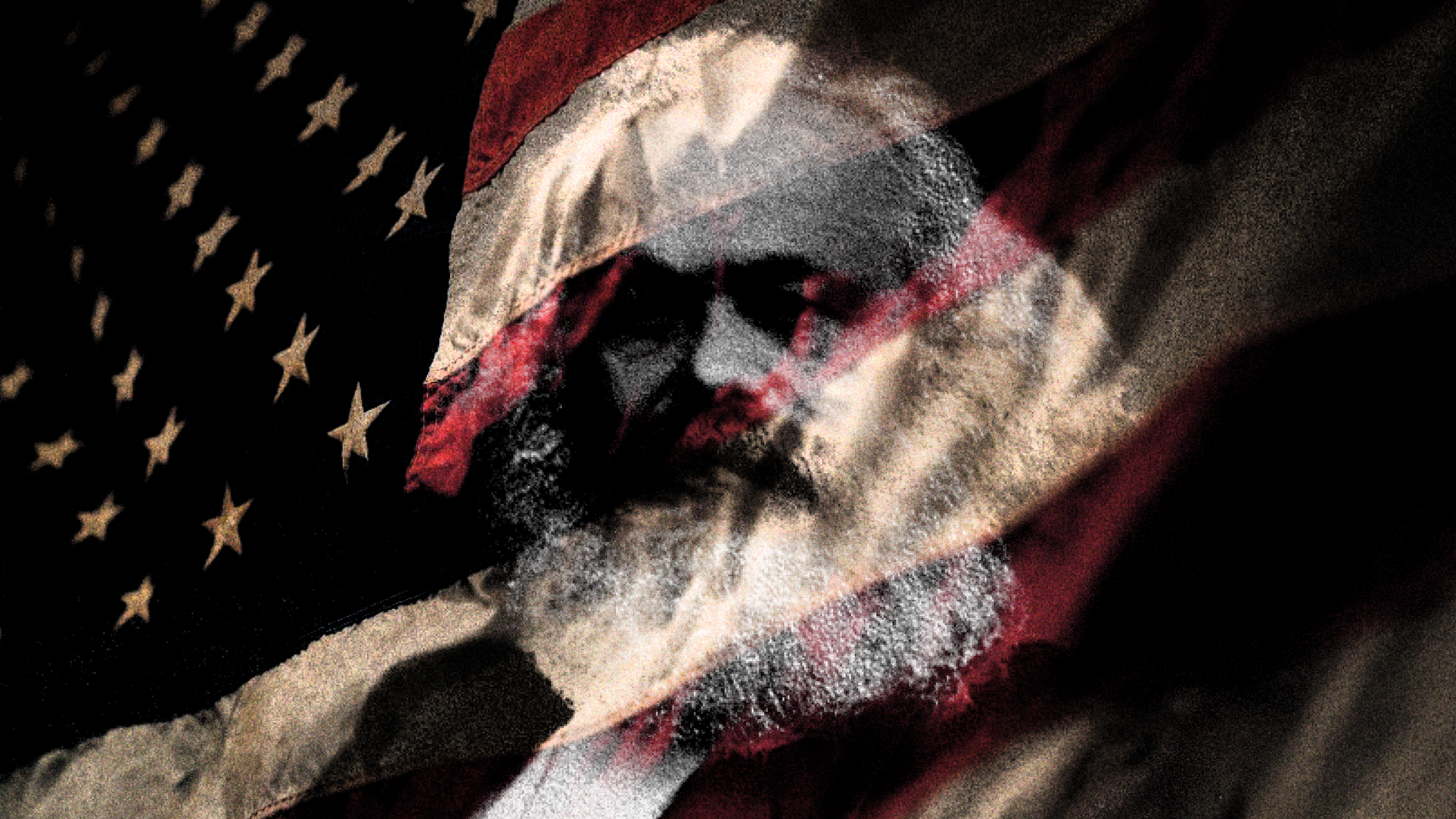
The further our country drifts away from moral sanity, the closer we drift toward false worldviews like Critical Theory, Marxism, Socialism, and Communism. While these terms probably feel more clinical and distant, they are actually the underbelly of popular movements like Black Lives Matter and the Democratic Socialists of America, influencers like Hasan Piker, or politicians like Bernie Sanders, Alexandria Ocasio-Cortez, and Zohran Mamdani. I hope you see that these isms (Marxism, Socialism, and Communism) are not just boogeymen; they have moved in and are ready to unpack. These are cultural buzzwords that carry just as much baggage as they do force.
The primary work of What is Critical Theory? A Concise Christian Analysis by Bradley Green is exploring, understanding, and engaging the school of thought called Critical Theory (1). Green wrote the book with two major parts: Part 1: Exploring the Origins of Critical Theory (chapters 1-2), and Part 2: Understanding and Engaging Critical Theory (chapters 3-7). These two parts are sandwiched between an introduction and conclusion.
Six Helpful Definitions
Whenever two or more people try and communicate, a necessary component is shared language. If I don’t speak the same language as someone, it will be difficult to carry a conversation, let alone an argument. Therefore, the following six definitions is my attempt to give language before I offer my critique. To be clear, these are my definitions (not to be confused with Bradley Green, who authored the book in review).
Critical Theory (CT) — A way of interpreting the world primarily through the lens of power: who holds it (the “oppressor”) and who doesn’t (the “oppressed”). Emerging from the Frankfurt School in the 1920s–30s, it adapted Marx’s economic categories into cultural, social, and ideological ones, arguing that a society’s institutions, norms, and even its ideas of truth serve to protect those in power.
Critical Race Theory (CRT) — An academic and legal framework, developed by scholars in the 1970s–80s, that applies this power lens to race and law. It holds that racism is not merely individual prejudice but is embedded within legal systems and institutions, producing unequal outcomes. In its framework, whiteness functions as the dominant category and racial minorities as the disadvantaged.
Marxism — A social, economic, and political theory from Karl Marx that reads history as a story of class struggle. Marx argued that under capitalism, the ownership class (the bourgeoisie) profits by extracting value from the labor of the working class (the proletariat), and that this conflict would ultimately drive revolution.
Socialism — An economic and political system in which the community or state, rather than private owners, controls the means of production, with goods and resources distributed according to need rather than market forces.
Communism — The flower that blooms from the bud of socialism. In Marx’s thought, the end goal toward which socialism is a transitional stage: a stateless, classless society in which private property is abolished and the means of production are held in common. Marx saw socialism as the bridge and communism as the destination.
Wokeism — A largely popular (rather than strictly academic) term for a worldview that extends the power-and-oppression framework into contemporary culture, emphasizing systemic injustice around race, gender, and sexuality. Supporters see it as a pursuit of justice; critics see it as an ideology that reduces complex realities to oppressor-versus-oppressed.
Tracing the History
Critical Theory did not come up out of nowhere. The movement’s inheritance runs back through Hegel and Marx. Green dates the key figures: G. W. F. Hegel (1770–1831), Karl Marx (1818–1883), and Friedrich Engels (1820–1895), noting critical theorists “drew many insights from G. W. F. Hegel (1770–1831)” (9). Sigmund Freud (1856–1939) also mattered, as “at least some members of this school saw Sigmund Freud’s (1856–1939) basic paradigm as essential to its work” (9).
The story really begins during World War I in Russia and Germany. Green writes that in “February 1917, the czars in Russia were removed from power. And nine months later, the Bolshevik Revolution occurred.” (15–16). He adds that “In 1918, Marxist initiatives in Germany gained ground, with the Communist Party (the KPD) eventually assuming control.” (16). The Marxist’s dreamed of a worker’s revolution, but it never came. Green writes, “Critical theory was birthed in the aftermath of World War I.” (9). The hoped-for German revolution failed, and “this led to something of a crisis for the critical theorists in general” (9–10). While the dream laid dormant, it was not dead.
“All roads lead back to the Institute for Social Research (Institut für Sozialforschung), founded in 1923 in Frankfurt, Germany.” (9) — hence “the Frankfurt School.” That same summer, “in the summer of 1923, Felix Weil (1898–1975) organized a seminar devoted to exploring why the hoped-for revolution had not occurred following World War I” (10), and the institute “was founded in 1923 and opened one year later” (10). Carl Grünberg (1861–1940) was “the first director of the Institute for Social Research, beginning his tenure in 1923” (12). With thinkers like Max Horkheimer, Theodor Adorno, Herbert Marcuse, Leo Lowenthal, and Fredrick Pollock. All of whom were referenced repeatedly by Green which shows his interest in honestly working with the architects instead of Straw Men and Red Herrings.
It wasn’t long before this rising movement is faced with a rival ideology. As Marxism and communism is growing, so is Nazism and fascism. “The growth of Nazism and fascism from 1924 to 1933 (especially with Hitler in Germany) seemed to move against the much-hoped-for Marxist revolution” (16). Under pressure, the Frankfurt Institute rushes to find new leadership. “Max Horkheimer became the director in 1930, and his own vision for the institute can be found in his 1931 inaugural address” (12). Nevertheless, Hitler was spreading throughout Europe, kicking Marx out. “With Nazism’s rise to power, the Institute for Social Research moved to Geneva in 1933 and to New York City (Columbia University) in 1935” (9). “Some critical theorists ended up in California in 1941” (9).
Marxism in America
“In the wake of 2020—the death of George Floyd and the aftermath of that event—there was a lot of talk about Cultural Marxism, Antifa, Black Lives Matter, Critical Race Theory, and so forth” and that “lurking behind those realities in various ways is this older movement of critical theory” (1). Green traces the line from the classical period to the present through “forms of conceptual similarity and overlap between the critical theory of the 1920s–1960s and contemporary radicalism or progressivism, including what is today called ‘wokeism’—especially via the influence of Herbert Marcuse” (13).
Since Frankfurt was “unapologetically Marxist” (9), Critical Theory would be impossible to understand without understanding Marxism. While Critical Theory is distinct from, but cannot be separated from, Marxism. Green writes, “Critical Theory is rooted in a generally Marxist interpretation and critique of modernity, but it has also significantly reworked and reinterpreted Marxism, while at times being compelled even to reject certain tenets of Marxism” (7).
Take, for example, these three belief statements from Black Lives Matter’s website:
“We disrupt the Western-prescribed nuclear family structure requirement by supporting each other as extended families and “villages” that collectively care for one another, especially our children, to the degree that mothers, parents, and children are comfortable” (58).
“We foster a queer-affirming network. When we gather, we do so with the intention of freeing ourselves from the tight grip of heteronormative thinking, or rather, the belief that all in the world are heterosexual (unless s/he or they disclose otherwise” (58).
“We are self-reflexive and do the work required to dismantle cisgender privilege and uplift Black trans folk, especially Black trans women who continue to be disproportionately enacted by trans-antagonistic violence” (59).
What I hope you are starting to realize is that bad ideas come from bad ideas and lead to bad impact. Let me try and illustrate this: Say I start to feel an ache in my neck. If I start to investigate where that ache is coming from, I’d go to the chiropractor, and I would find out that my hips are out of alignment. If I continue to investigate why my hips are out of alignment, I’d find out that I have sand in my right shoe (which I conveniently never noticed). If I continued still to investigate where this sand is coming from, I’d find out that there’s a hole in the wall next to where I put my shoes in the garage. Our present cultural disaster is the neck ache, and Marxism is the hole in the wall.
How did we get to the point in our culture where phrases like “free ourselves from the tight grip of heteronormative thinking” or “dismantle cisgender privilege” are considered as respectable, moral ideas. America has a steering wheel on her back and Karl Marx is driving. Critical Theory, Critical Race Theory, Cultural Marxism, and even straight up Communism (thanks to the present coalition of Far-Left Democrat leaders like Sanders, AOC, Mamdani).
A Strange but Real Fruit of Marxism
Sexual perversion is a strange, but real fruit of Marxism. You read that right. Marxism actually leads to sexual perversion. At least that’s what men like Herbert Marcuse, Wilhelm Reich, and Sigmund Freud would hope it would lead to. If it seems strange to you that economic and political systems would lead to grotesque sexual degeneracy, then your conscience is still intact. Consider what American political philosopher, Richard Weaver, wisely wrote, “Ideas have consequences.”
What on earth does Karl Marx’s idea of workers seizing the means of production have to do with drag queen story hour? The missing link is a man named Herbert Marcuse. Remember, Green already told us the Frankfurt School “drew many insights” from Freud, whose “basic paradigm” some members saw “as essential to its work” (9).
Marx said that the worker is alienated—robbed of the value his labor produces. Marcuse took that category of alienation and moved it from the factory to the bedroom. For Marcuse, “labor time… is painful time, for alienated labor part of the individual’s life time, is absence of gratification, negation of the pleasure principle” (83). Do you see connection? Alienated labor becomes repressed desire. In the same way that workers ought to rise up and fight against the ruling class, women and men ought to rise up and fight against the biblical sexual ethic. Oppression is no longer economic (Communism and Socialism), but it is racial (CRT and Cultural Marxism), and now sexual.
Marcuse “took for granted ‘Freud’s proposition that civilization is based on the permanent subjugation of the human instincts’” (81). Read that again. Civilization itself—order, restraint, the rules that make society function—is the enemy, because it subjugates (or controls) our instincts. So, the revolution Marx wanted against capitalism now becomes a revolution against sexual restraint. Marcuse wrote that progress “would depend completely on the opportunity to activate repressed or arrested organic, biological needs: to make the human body an instrument of pleasure rather than labor” (81). The body stops being for work and starts being for pleasure.
This is not a stretch or out of context. Marcuse speaks positively of “polymorphous sexuality” (81). This is a term Freud gives for desire unbound from any natural order or purpose. Marcuse continues to point out his problem: society “condemns or marginalizes ‘as perversions’ practically all [the sex instinct’s] manifestations which do not serve or prepare for the procreative function” (84). All of the sexual practices that do not naturally lead to procreation (homosexuality, pedophilia, and bestiality/zoophilia) are sexual perversions because they are not in alignment with God’s good design for sexuality. Marcuse, however, says that the perversions aren’t the problem, society is.
Green helpfully articulates their argument for them: “these various sexual perversions are rebelling against the notion that sexuality has as a key goal the procreation of children, and these same perversions are in rebellion against the institutions” (84–85). Sex severed from childbearing isn’t just permitted—it’s revolutionary.
Marcuse’s opposition to procreation was an opposition to “paternal domination” and “the patriarchy” (85), and Green notes the two institutions named for dismantling are “the traditional family and... traditional religious organizations (including the church)” (85). His colleague Wilhelm Reich was even blunter: he wanted to “dismantle those forces in a society (e.g., the traditional family, the church) that impede one’s basic sexual desires and longings” (79). Reich argued that sexual restraint “leads ultimately to fascism” (78–79), and that only outside “capitalist and patriarchal systems” could man live “honestly, industriously and cooperatively” (77). Restrain sex, and you get fascism. Free sex, and you get liberation.
A Biblical Critique of Critical Theory
The hope of the gospel is far more transforming, compelling, and healing than anything else offered—Marxism, Communism, Socialism, or Critical Theory. “The world God made was good, real, and morally structured. This is quite a different vision of things than what we see in critical theory” (61).
I appreciate Green’s graciousness. He admits, “ “Critical theory was and is right to look at the world and say, ‘Something is not right here’” (65). The ache in the neck is real. Where critical theory goes wrong is not in feeling the ache but in misdiagnosing the hole in the wall. For all of its talk on liberating the oppressed, critical theory never actually gets to the bottom of what’s wrong. “A truly Christian response to critical theory must show that it is not—ironically—critical enough. Christianity truly gets to the heart of the matter and actually is the most truly ‘critical,’ in the sense that the Christian message offers a true understanding of reality and what is wrong with the world and likewise offers the true solution to the myriad challenges, problems, and sufferings experienced and seen in the world” (8-9).
The dark underbelly of the whole system is a particular picture of the human person. Critical theory works “with an anthropology wherein what is most important is the solitary individual and his or her desires and will (and for Marcuse this is fundamentally sexual desire)” (65). The movement that claims to fight for the collective, for the oppressed, for community, is actually built on the sovereign, isolated self and its appetites. In fact, the critical theorists “were still staunchly committed to at least one Enlightenment principle: the virtually unchallengeable place and sovereign role of the isolated individual” (65). The self is god, and its desires—especially its sexual desires—are the final authority. Paul wrote, “Their end is destruction, their god is their belly, and they glory in their shame, with minds set on earthly things” (Philippians 3:19). This is why it is “no surprise when we see present-day heirs of critical theory expressing clear contempt for the traditional family” (65). If the sovereign self and its desires are ultimate, then any institution that asks that self to submit—the family, the church, the created order of man and woman—becomes an enemy to be dismantled.
The Christian offers a better word. The union of man and woman is “a good thing... a part of the good order created by God” (65). Green’s final diagnosis is the most searching of all: the problem was not that they knew too little, but that “they were pretending not to know what they knew (i.e., that they knew God, Rom. 1), they were engaging in a sustained project of self-deception. Yet eternity was set in their hearts (Eccl. 3:11)” (187).
Christians, too, “seek to destroy strongholds (2 Cor. 10:5).” But we do not tear down for the sake of tearing down. The real question, once the debris is cleared, is whether “we have anything to put in their place” (170)—and critical theory, for all its demolition, has left the house empty. Marx offered a revolution with no redemption; Marcuse offered a liberation with no rest. Strip away God, and criticism becomes nothing more than “a kind of Nietzschean ‘will to power’... a display of raw power” (170).
The truth, goodness, and beauty of the gospel is that the world was made good, but we have broken it, and Christ has come to make it new.